

Agentic VoiceDSP
For the complete documentation index, see llms.txt.
Benefits
Agentic VoiceDSP combines Silero VAD, Pipecat turn detection, and optional Hush noise suppression in one VoxEngine module.
You can still import those modules one by one. VoiceDSP is the path that gives you a single client, one media target, and high-level user-turn events.
Use it when you build your own LLM application. It also fits any speech-processing scenario that needs turn boundaries.
Capability highlights:
- One WebSocket connector for VAD, turn detection, and optional noise suppression.
- Start and stop strategies that emit
TurnStarted,TurnInferenceTriggered, andTurnStopped. - Optional ASR gating so you can start LLM inference before the final transcript arrives.
- Idle and watchdog timers that follow the Pipecat user-turn model.
How it works
Agentic.createVoiceDSP opens a client to the bundled /agentic/voice_dsp connector. The connector runs Silero voice-activity detection, Pipecat Smart Turn, and optional Hush noise suppression, then applies your start and stop strategies.
The turn lifecycle follows Pipecat UserTurnProcessor and TurnAnalyzerUserTurnStopStrategy.
Smart Turn flow
- VAD detects a pause, and the turn detector runs (
Predict). - If the model returns end of turn, VoiceDSP emits
TurnInferenceTriggered, thenTurnStoppedafter transcript gating when ASR is configured. - If the model returns incomplete, silence has to continue for
stopSecsseconds. VoiceDSP then emitsTurnStopTimeoutwithreason: stop_secs, thenTurnStopped.
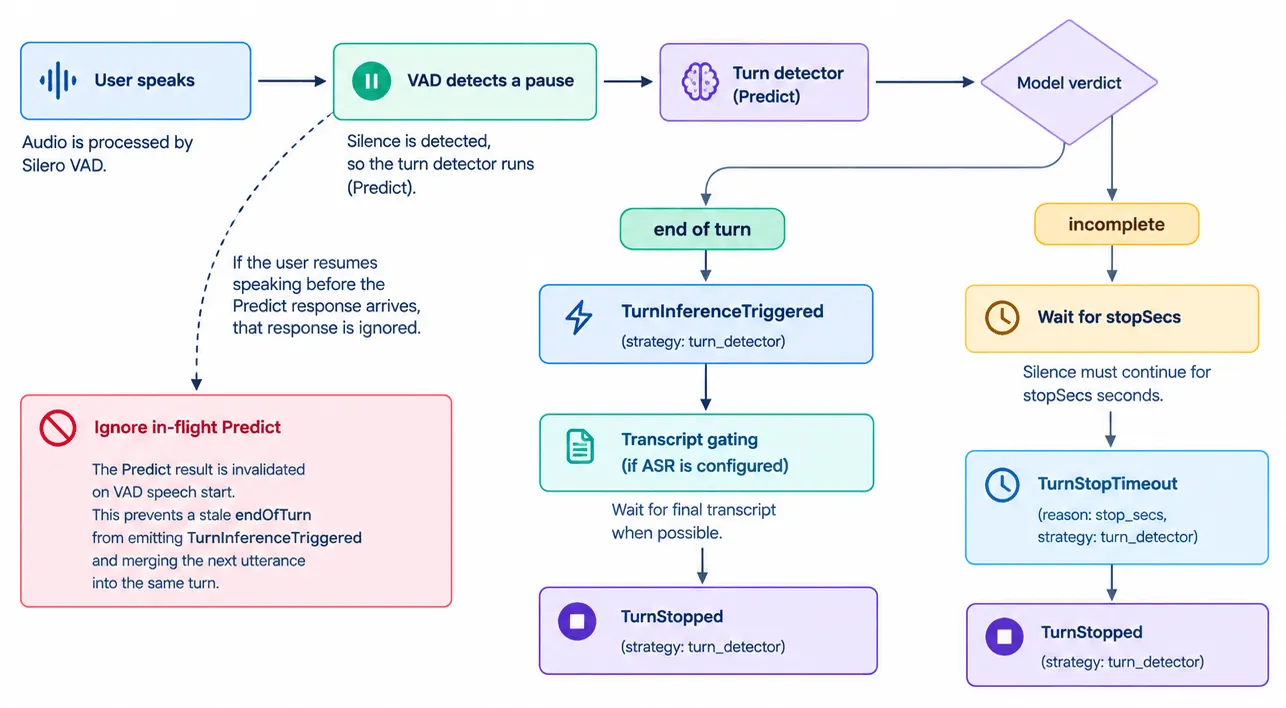
If the caller resumes speaking before the Predict response arrives, VoiceDSP ignores that response. An in-flight Predict is invalidated on VAD speech start, so a stale endOfTurn cannot emit TurnInferenceTriggered or merge the next utterance into the same turn.
VoiceDSP handles stopSecs in the scenario runtime. It does not forward stopSecs to the connector.
Stop-strategy precedence
When several stop strategies are configured, they are ranked so one turn always finalizes with one strategy. TurnInferenceTriggered.strategy and TurnStopped.strategy stay the same:
controller_timeout— the user-turn-stop watchdog. It always wins, including when a transcript is still pending. It reuses the pending strategy label, or the configured fallback if nothing is pending.turn_detector— the model verdict, plus itsstopSecsfallback, which is still labeledstrategy: 'turn_detector'. This path is authoritative.speech_timeout— a pure fallback.
A speech_timeout fallback does not pre-empt or relabel the model turn_detector while that detector is engaged for the current segment. That includes a pending Predict verdict, a pending turn_detector finalize, and the stopSecs fallback armed after an endOfTurn: false verdict. When turn_detector and speech_timeout are both configured, the detector (with its stopSecs fallback and the controller_timeout watchdog) owns every finalization path. speech_timeout fires only when turn_detector is not configured.
TurnInferenceTriggered.strategy and TurnStopped.strategy always match a configured stop strategy. If you omit turn_detector from stopStrategies (tests, or ASR-only stop logic):
- VoiceDSP does not send
Predict. - Connector
Turn.Resultis ignored. - Events never report
strategy: 'turn_detector'. The watchdog still force-stops withTurnStopTimeoutreason: controller_timeout, labeled with the configured fallback (speech_timeout).
ASR transcript gating
Pass an ASR instance to Agentic.createVoiceDSP when you want transcript-aware turns:
- Transcription-based start strategies (
transcription,min_words) can emitTurnStarted. TurnStoppedwaits for a final transcript when it can.- If the turn analyzer finishes before ASR,
TurnInferenceTriggeredfires first so the scenario can start LLM inference early. - An ASR grace timer (
asrGraceTimeout, default 0.3 seconds) starts atTurnInferenceTriggered. Until it expires, later ASR interim or final results update the snapshot used byTurnStopped. A final transcript finalizes the turn immediately. Keep the default shorter than typical ASR final latency soTurnStoppeddoes not wait for the ASR final; start the LLM onTurnInferenceTriggered. When the timer expires,TurnStoppeduses the latest snapshot, including interim text. - After
TurnStopped, late ASR interim or final results for the closed utterance are ignored until a new speech segment (VAD speech start) or a new turn start. That prevents a ghostTurnStartedand content bleed into the next turn.
Pass the same ASR instance you send call media to:
Without asr, those start strategies never fire. Do not rely on instanceof across Modules.ASR and Modules.Agentic. VoiceDSP accepts any ASR-like object with event listeners.
User turn stop watchdog
userTurnStopTimeout (default 5.0 seconds, same idea as Pipecat user_turn_stop_timeout) forces turn finalization when a turn stays active and no stop strategy fires. VoiceDSP emits TurnStopTimeout with reason: controller_timeout, then TurnStopped. The inference and stop events reuse the pending strategy, or the configured fallback if none is pending. They never use turn_detector unless that strategy is configured.
User idle
This timer follows Pipecat UserIdleController. It is separate from Smart Turn stopSecs.
- Set
userTurnIdleTimeoutin seconds. 0 disables it. - Call
signalAssistantTurnEnded()when TTS or LLM playback finishes. That clears the assistant-speaking state and starts the idle timer if the caller is not in an active turn. - Call
signalAssistantTurnStarted()when the assistant starts speaking. That marks the assistant as speaking and cancels the idle timer. TurnStarted.interruptedistrueonly when the user turn starts while the assistant is speaking. That requires the signal calls above. It is not a copy of the strategyenableInterruptionsflag.- When the assistant is speaking and a start strategy has
enableInterruptions: false,TurnStartedis suppressed. - User speech or
TurnStartedalso cancels the idle timer.
Noise suppression
Pass noiseSuppressionParameters to enable Hush inside the bundled connector. The parameter shape matches Hush.NoiseSuppressionParameters (attenLimDb). Developer-only model and cpuCount stay hidden.
- Omit
noiseSuppressionParametersto leave noise suppression off. - Do not
require(Modules.Hush)for this path. Hush runs server-side in the VoiceDSP connector, not as a separateHush.createNoiseSuppressionmedia unit. For the separate unit and its explicit media routing, see the Hush noise suppression guide. - Denoised audio stays inside the connector pipeline, before VAD and turn detection. The scenario still sends call media only to
Agentic.VoiceDSP.
Usage
- Create an
Agentic.VoiceDSPinstance withAgentic.createVoiceDSPand your parameters. - Send call media to it with
call.sendMediaTo. - Pass an ASR instance when you use transcription-based start strategies (
transcription,min_words). - Set
turnDetectorParameters.stopSecs(default 3.0). - Optionally set
asrGraceTimeout,userTurnStopTimeout, anduserTurnIdleTimeout. - Call
signalAssistantTurnStartedandsignalAssistantTurnEndedfrom your TTS or LLM playback lifecycle. - Configure start and stop strategies with
Agentic.VoiceDSPStrategiesfactories. - Listen to
Agentic.VoiceDSPEventsand implement your application logic.
Silero VAD and Pipecat turn-detector signals stay inside VoiceDSP. Scenarios see the high-level VoiceDSP events, not the raw detector events.
The scenario below is the reference incoming-call setup: it creates VoiceDSP, sends call media to it, and logs turn events.
Links
Voximplant
- VoiceDSP API reference
- VoiceDSP events
- VoiceDSP strategies
- Voice Activity Detection
- Turn Detection
- Hush noise suppression